Four plugs, three markets, and where the rectifier sits
The connector on the car is a regional decision, not a technical one. What actually separates charging types is whether the conversion from alternating to direct current happens inside the car or inside the charger.
Every argument about charging connectors is really two questions wearing one coat. The first is electrical and universal. The second is regional and political.
AC or DC: where the conversion happens
A battery stores direct current. The grid supplies alternating current. Something has to convert between them, and the only question is where that something sits.
In AC charging, the grid's alternating current goes into the car, and a rectifier inside the car does the conversion. That unit is called the onboard charger, and it is a physical box with a fixed rating, usually between 7 and 22 kW. Plugging into a more powerful AC supply changes nothing: the onboard charger is the ceiling. This is home and workplace charging, and it is measured in hours.
In DC charging, the conversion happens inside the charging station, which can be the size of a wardrobe and cooled properly. It then feeds direct current straight to the battery, bypassing the onboard charger entirely. That is why DC charging reaches hundreds of kilowatts, and why the equipment is expensive and lives beside motorways rather than in garages.
The car's DC limit is then set by the pack and its thermal management, not by the socket, and the peak it quotes is a rate rather than an amount: see kW against kWh.
The connectors, by market
Type 2 (IEC 62196-2) is the European AC connector, mandated for public AC points in the EU.
CCS Combo 2 adds two DC pins beneath a Type 2 socket, so one port handles both. It is the European DC standard. North America used Combo 1, built on the Type 1 AC connector.
NACS (standardised as SAE J3400) is the connector Tesla developed and then opened, and which most makers selling in North America have committed to. It carries both AC and DC through the same pins, which is why the plug is smaller.
GB/T (GB/T 20234) is the Chinese standard, with separate AC and DC connectors. It is the reason a car built for the Chinese market does not arrive in Europe with the right socket.
CHAdeMO was the early Japanese DC standard. It is in decline outside Japan.
None of these differences is about capability. They are the outcome of which standard a region adopted and when, which is why adapters exist and why the industry keeps consolidating.
Sources
Terms defined here
- Onboard charger
- The rectifier inside the car that converts alternating current from the grid to the direct current the battery needs. Its rating, typically 7 to 22 kW, is the hard ceiling on AC charging speed.
- CCS
- Combined Charging System. An AC connector with two DC pins added below it, so one socket serves both. Combo 2 is the European variant, Combo 1 the North American.
Related reading
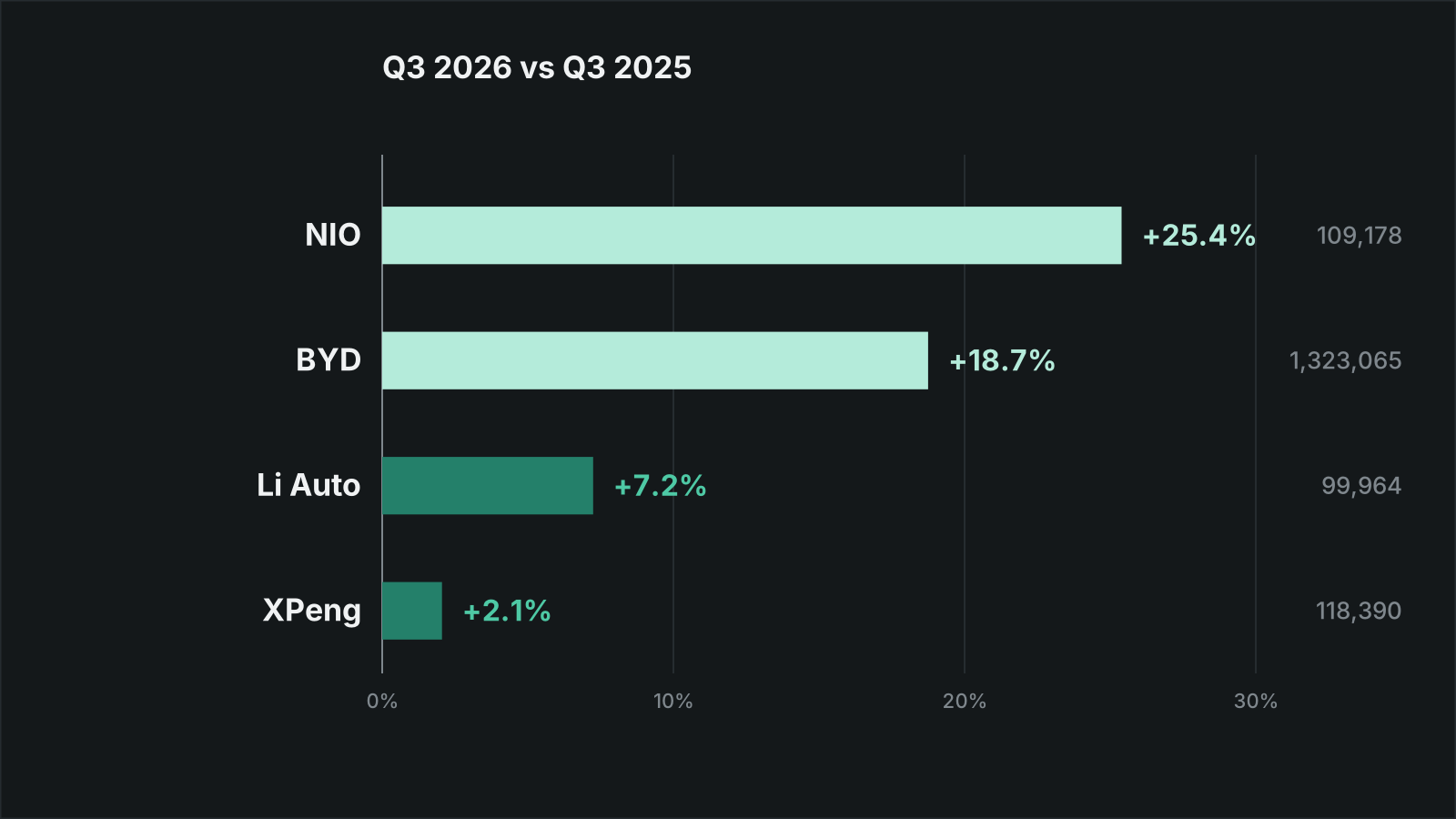
Q3 deliveries: NIO and BYD grew by double digits, XPeng and Li Auto did not
NIO delivered 109,178 vehicles in the third quarter (+25.4%) and BYD sold 1,323,065 (+18.7%). XPeng's 118,390 was up 2.1% and Li Auto's 99,964 up 7.2%. The growth came from NIO's premium brand and BYD's exports.
1 Oct 2026 · Analysis · 6 min
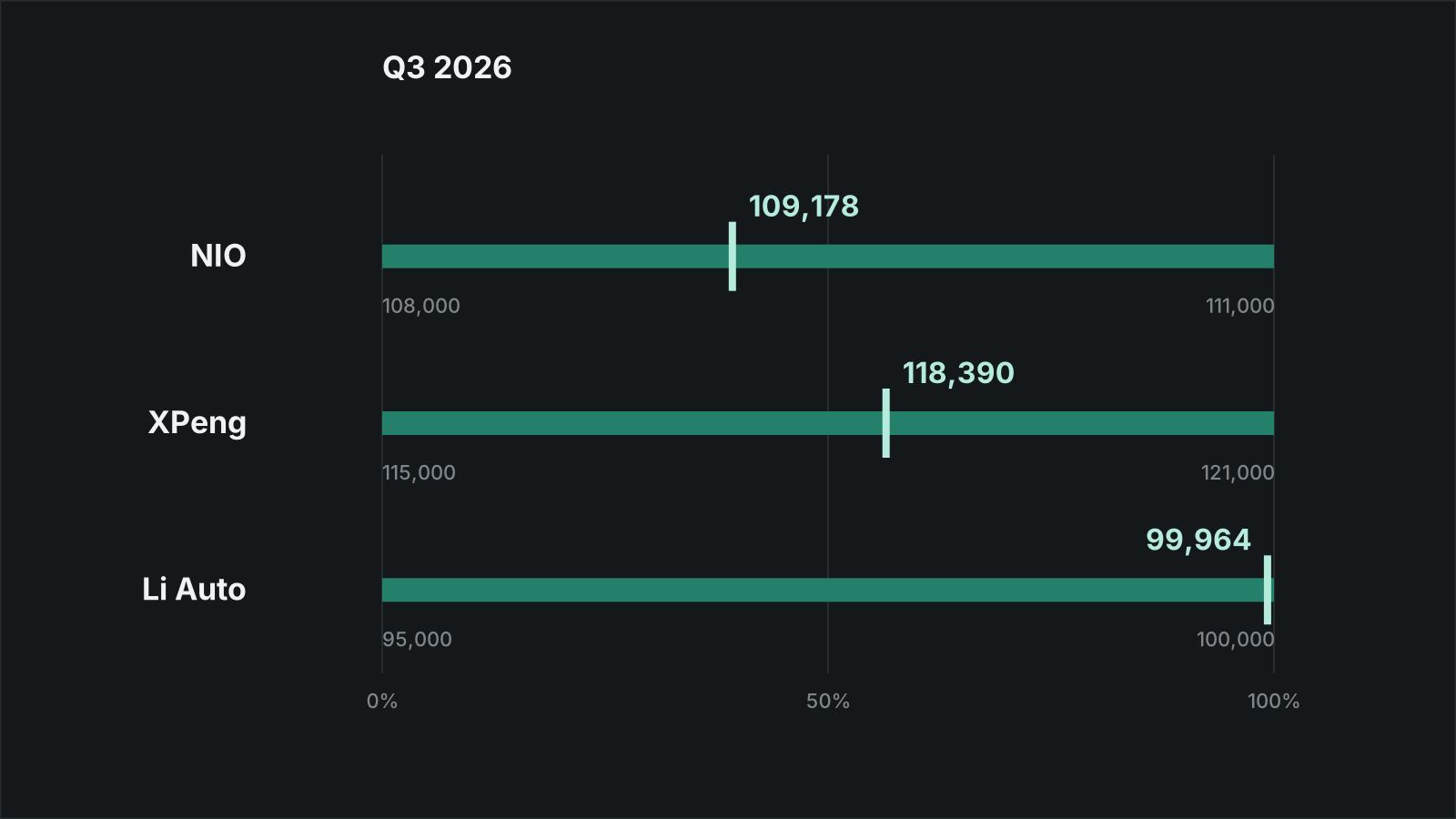
Q3 guidance scorecard: three hits, and Li Auto finished 36 vehicles from its ceiling
NIO, XPeng and Li Auto each delivered inside the third-quarter range they gave. NIO landed 39.3% of the way up its range, XPeng 56.5%, Li Auto 99.3%. All three set their ranges with part of the quarter already delivered.
1 Oct 2026 · Analysis · 6 min
An electric motor, a petrol engine and a diesel engine, measured on efficiency
The three drivetrains differ in how much of their fuel reaches the wheels, where their torque arrives, and how many parts they need to do it. The efficiency gap is the largest of the three, and the least discussed.
Updated 17 Sept 2026 · Explainer · 2 min