Hybrid, plug-in, range extender: where the engine actually connects
Three drivetrains sold under one word. The difference that matters is whether the engine can drive the wheels at all, and how much battery sits behind it.
The word hybrid covers at least three arrangements that behave differently enough to be separate products.
Parallel: the engine drives the wheels
In a conventional hybrid, the engine has a mechanical connection to the wheels, and an electric motor assists it. The battery is small, in the region of one to two kilowatt-hours, and there is no plug: it is charged by the engine and by regenerative braking.
It is best understood as a petrol car with a very good start-stop system and some electric assistance. Electric-only range is a few hundred metres at low speed, which is why the category does not advertise one.
Plug-in: the same idea, with a real battery
A plug-in hybrid keeps the mechanical connection but enlarges the battery, to roughly 10 to 25 kWh, and adds a plug. That is enough for a typical commute on electricity alone, with the engine available beyond it.
For what each drivetrain does with its energy, see electric against petrol and diesel.
The compromise is that the car carries both drivetrains in full, with the mass and cost of each. Whether it is efficient in practice depends entirely on whether the owner plugs it in, which is the honest caveat on every fleet consumption figure for the category.
Series and EREV: the engine never touches the wheels
In a range extender the engine has no mechanical path to the wheels at all. It turns a generator, the generator feeds the motor or the battery, and the wheels are driven electrically at every moment.
The driving experience is therefore electric throughout: no gear changes, no engine note that rises with road speed. The engine is free to run at whatever speed is most efficient, because it is not tied to how fast the car is going.
Chinese makers have pushed this layout hardest, and Li Auto built its early range on it. The commercial logic is specific: an EREV needs a smaller battery than a comparable battery electric car, which cuts the most expensive component, while sidestepping the charging network question in markets where it is not yet dense enough.
Why this matters when reading Chinese delivery numbers
China's new energy vehicle category includes battery electric, plug-in hybrid and range-extended cars. A reported NEV figure is therefore not a battery electric figure, and the mix between them moves.
This is the single most common misreading of Chinese volume data, and it is worth checking the split before comparing an NEV number against a maker that sells battery electric cars only.
Sources
Terms defined here
- EREV
- Extended-range electric vehicle. A series hybrid in which the combustion engine drives a generator only and has no mechanical path to the wheels.
- Series hybrid
- A layout where the engine generates electricity and the motor alone drives the wheels.
- Parallel hybrid
- A layout where both the engine and the motor can drive the wheels, together or separately.
Related reading
What EV gross margin actually measures, and why the Chinese makers report it differently
XPeng's gross margin rose from 17.3% to 20.7% over a year in which its cars got less profitable, not more. Both numbers come from the same filing. Here is how that works.
12 Sept 2026 · Deep dive · 8 min
What a 70 per cent warranty floor actually commits a maker to
Batteries lose capacity through two separate mechanisms, only one of which is driving. Here is what degrades a pack, what a state-of-health figure means, and what the standard warranty does and does not promise.
Updated 17 Sept 2026 · Explainer · 2 min
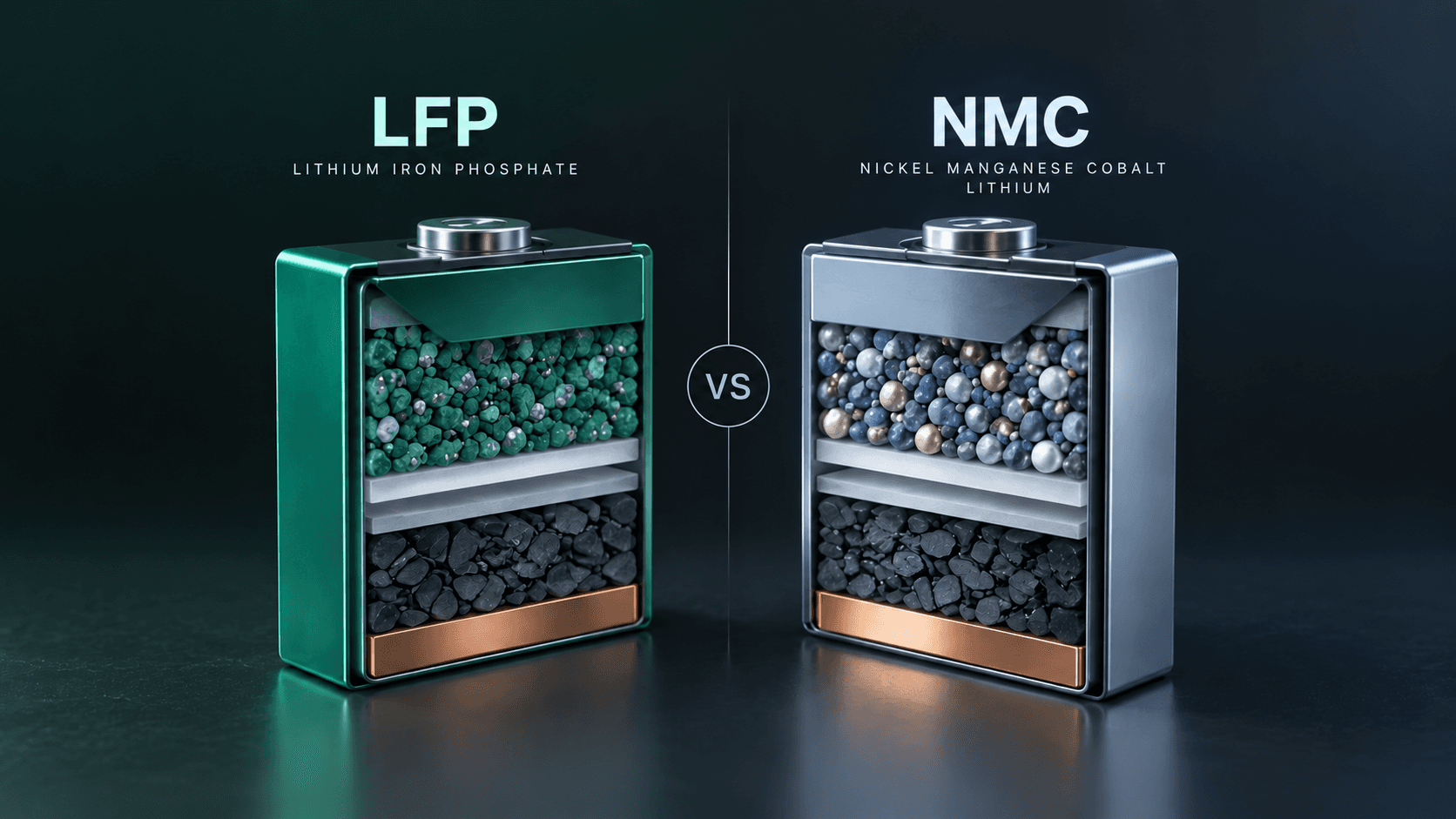
LFP vs NMC: the two battery chemistries that split the EV market
An LFP pack cost $81 per kWh in 2025. The nickel equivalent cost $128. That $47 gap explains most of what has happened to electric car prices, and to the league table of who builds the cells.
12 Sept 2026 · Deep dive · 6 min
More on Li Auto
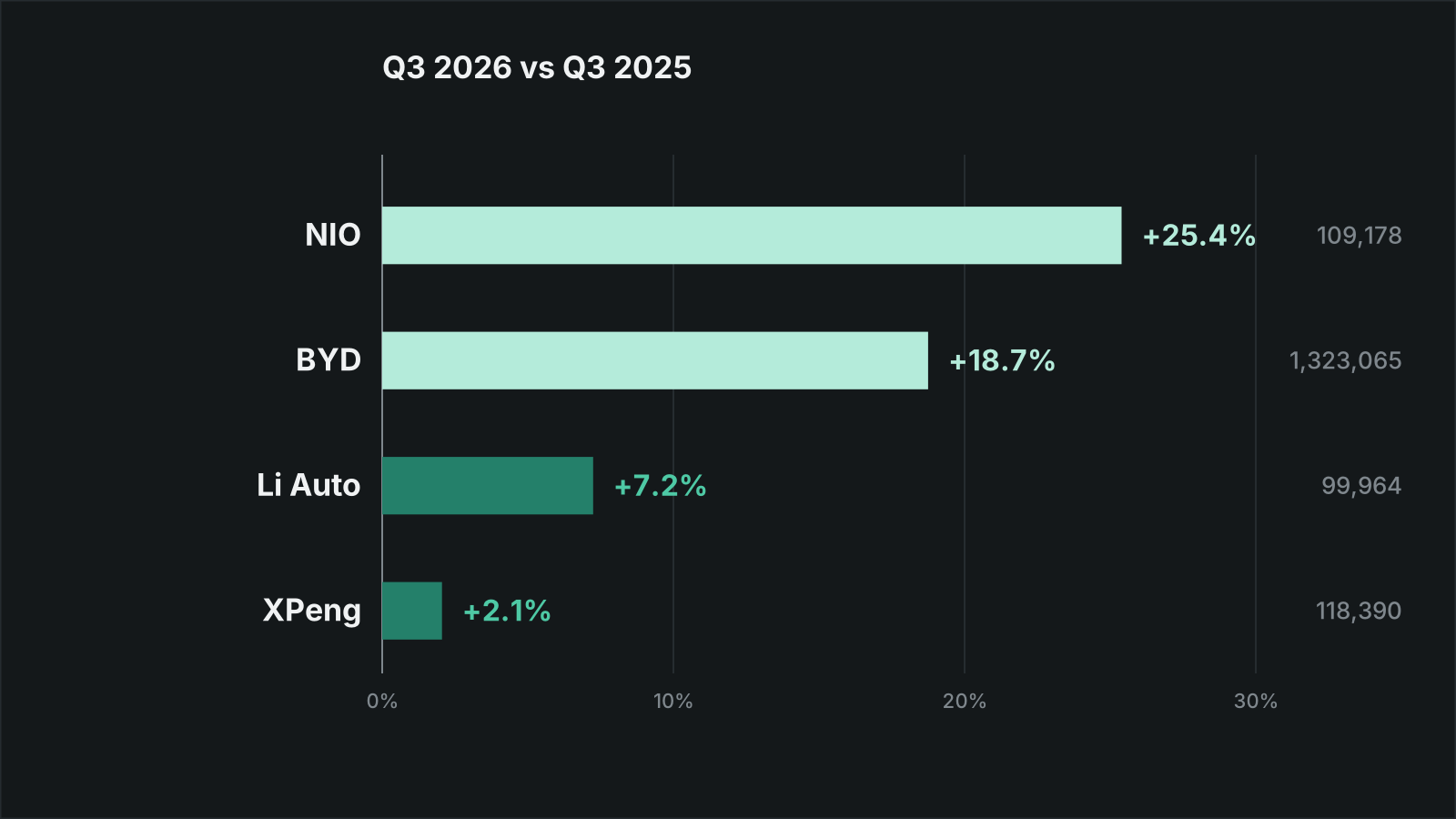
Q3 deliveries: NIO and BYD grew by double digits, XPeng and Li Auto did not
NIO delivered 109,178 vehicles in the third quarter (+25.4%) and BYD sold 1,323,065 (+18.7%). XPeng's 118,390 was up 2.1% and Li Auto's 99,964 up 7.2%. The growth came from NIO's premium brand and BYD's exports.
1 Oct 2026 · Analysis · 6 min
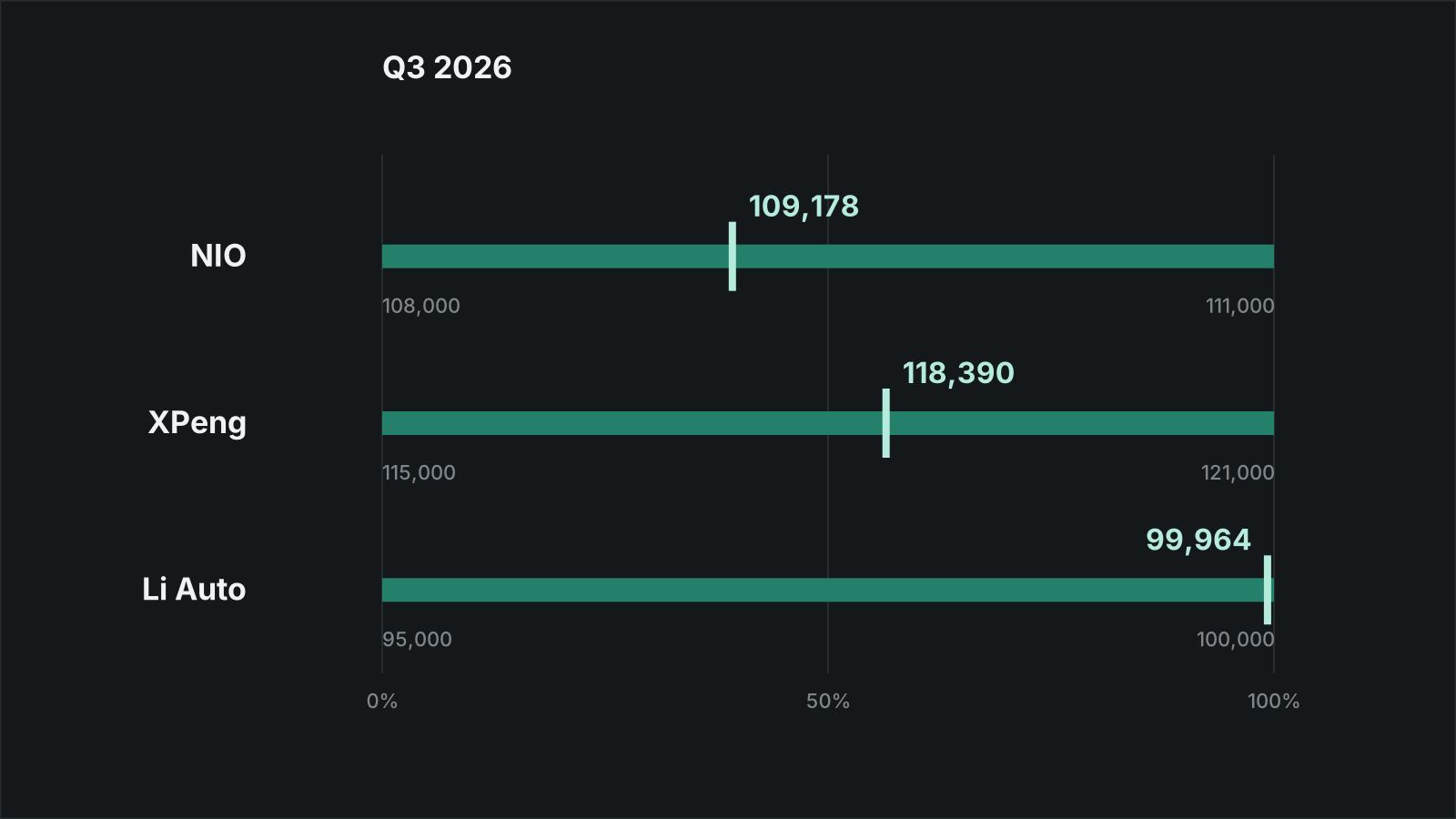
Q3 guidance scorecard: three hits, and Li Auto finished 36 vehicles from its ceiling
NIO, XPeng and Li Auto each delivered inside the third-quarter range they gave. NIO landed 39.3% of the way up its range, XPeng 56.5%, Li Auto 99.3%. All three set their ranges with part of the quarter already delivered.
1 Oct 2026 · Analysis · 6 min
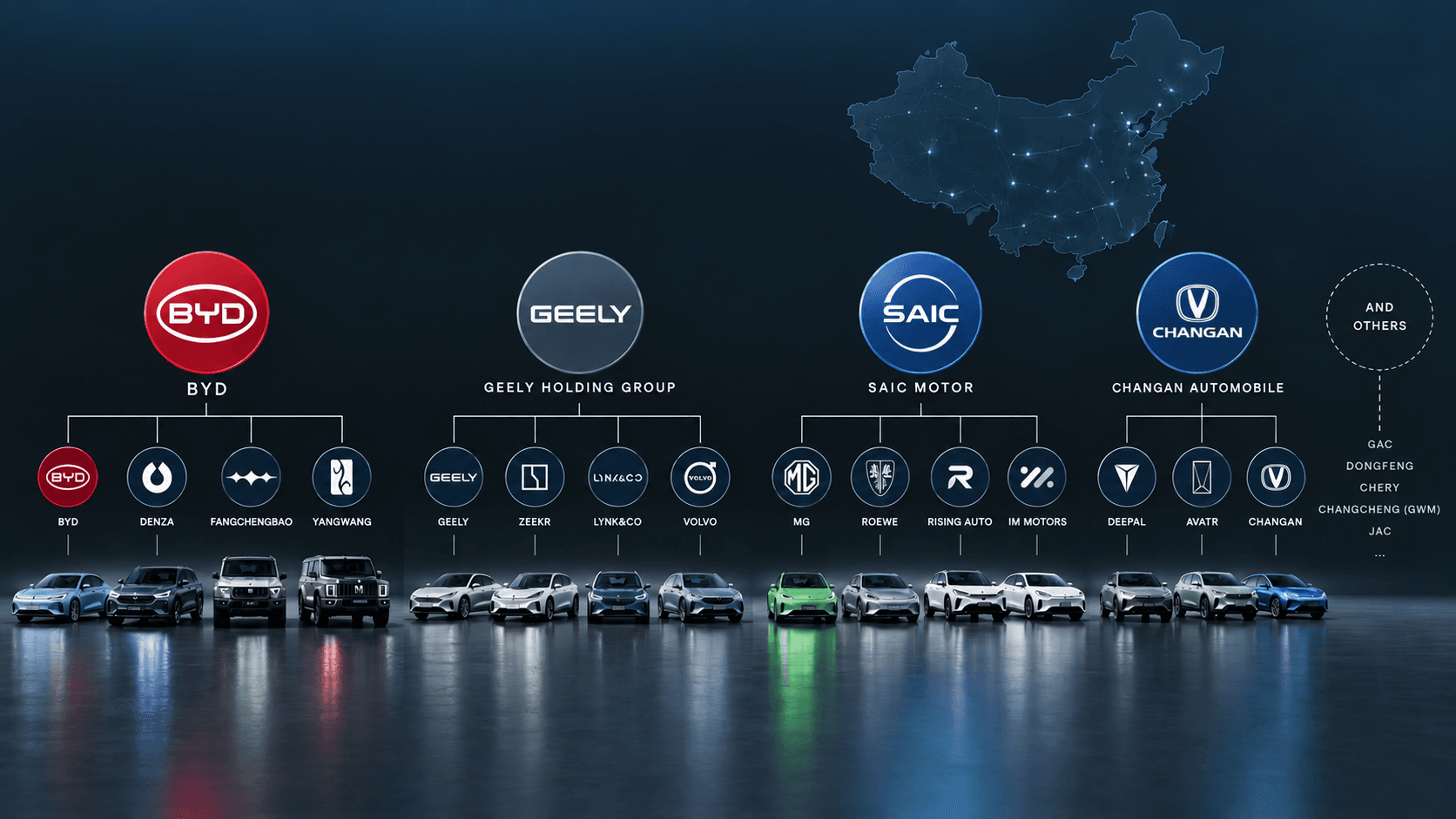
Chinese EV brands: who owns what
Denza, Yangwang, ONVO, MONA, Zeekr, Lynk & Co, MG, Avatr. Most of the names arriving in Europe belong to seven groups, one of which also owns Volvo, and one phone company that owns no carmaker at all.
12 Sept 2026 · Deep dive · 10 min
More on BYD Co
From cell to pack, and what cell-to-pack took out
A car battery is built in three layers, and each one adds mass that stores no energy. Removing the middle layer is why a pack figure and a cell figure have moved apart.
Updated 17 Sept 2026 · Explainer · 2 min
The one number the electric car investment case turns on
Battery cost per kilowatt-hour decides whether an electric car can be sold at a profit. The figure is quoted constantly and defined loosely, and cell price and pack price are not the same number.
Updated 17 Sept 2026 · Explainer · 2 min
An electric motor, a petrol engine and a diesel engine, measured on efficiency
The three drivetrains differ in how much of their fuel reaches the wheels, where their torque arrives, and how many parts they need to do it. The efficiency gap is the largest of the three, and the least discussed.
Updated 17 Sept 2026 · Explainer · 2 min